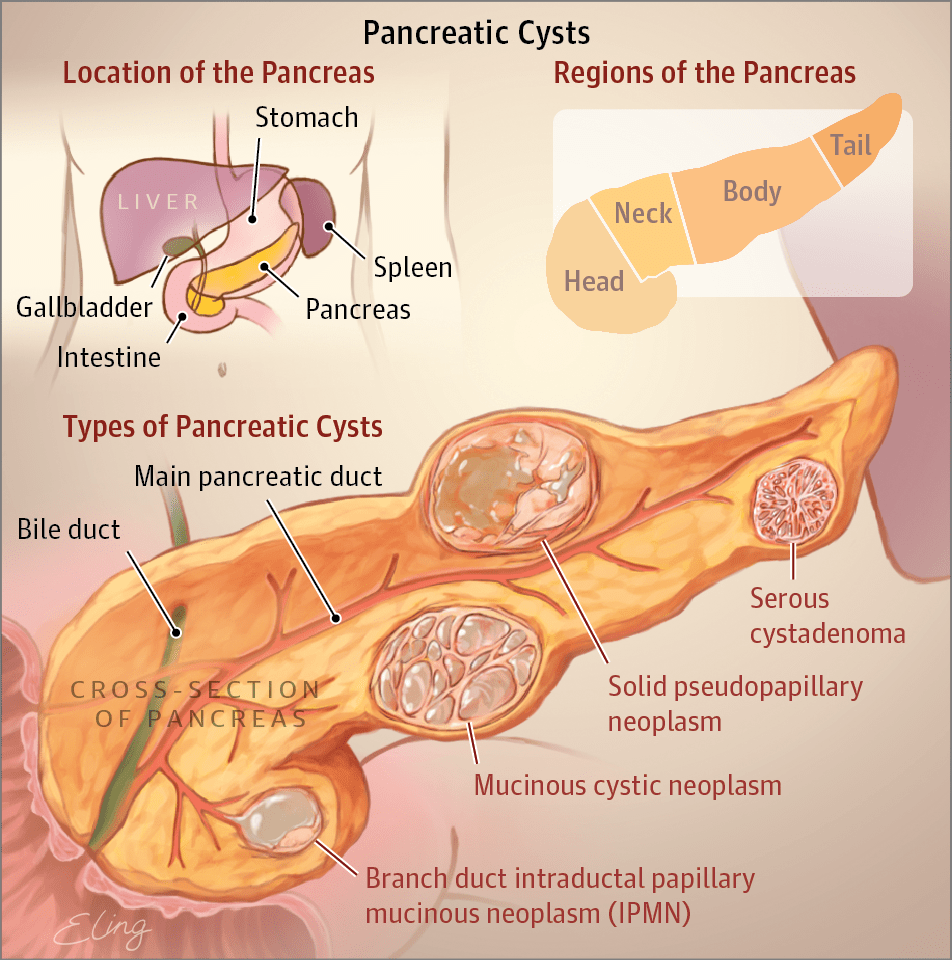
Pancreatic cysts are common, found in roughly 3% of all imaging studies and increasing with age. The term “pancreatic cyst” encompasses a wide range of abnormalities with different risks and strategies for diagnosis and management. Most pancreatic cysts post no cancer threat, but a small percentage are considered pre-cancerous. Evaluation by teams specializing in this complex diagnosis and management including surgeons, gastroenterologists, radiologists and oncologists ensures the best outcome for each unique patient.
There are different types of pancreatic cysts, and they can be classified into two main categories:
1. Non-Neoplastic (non-cancerous) Cysts:
– Pseudocysts: These cysts are typically formed as a result of inflammation or injury to the pancreas. They are filled with fluid, and they are not lined with special cells. (Click here to read more about pseudocysts)
– Serous Cysts: These are usually benign cysts filled with clear fluid. They are lined with special cells that produce the fluid. (Click here to read more about Serous Cystadenomas)
2. Neoplastic (cancerous) Cysts:
– Mucinous Cysts: These cysts have a lining that produces mucin, a thick fluid. Some mucinous cysts can have the potential to develop into cancer. (Click here to read more about Mucinous Cysts)
– Intraductal Papillary Mucinous Neoplasms (IPMN): These are precancerous growths that can develop in the main pancreatic duct or its branches. (Click here to read more about IPMN)
Symptoms:
– Many pancreatic cysts are asymptomatic and are discovered incidentally during imaging tests for other conditions.
– Symptoms may occur if the cyst becomes large or if it causes blockage of the pancreatic duct.
Diagnosis:
– Imaging tests such as CT scans, MRI, or endoscopic ultrasound (EUS) are commonly used to diagnose pancreatic cysts.
– Fine-needle aspiration (FNA) may be performed to collect a sample of fluid for analysis.
Treatment:
– The approach to treatment depends on the type of cyst and whether it is causing symptoms.
– Observation may be recommended for small, asymptomatic cysts.
– Surgical removal of the cyst may be necessary in cases where symptoms are present or if there’s a concern about cancer.
Mission Surgery employs a team approach with the latest in technology for diagnosis and monitoring of pancreatic cysts. When surgery is necessary, many procedures can be performed using small incisions and the Da Vinci robot allowing for faster recovery.
 Jesse Sulzer MD PhD